Introducing Vanguard's new Target Maturity Corporate Bond ETF suite
A simpler tool for customization and goals-based planning

A simpler tool for customization and goals-based planning
Este artículo está disponible sólo en inglés.
Ten new Vanguard ETFs that act like individual bonds: Vanguard’s new suite of corporate bond target maturity ETFs (TMEs or BondBuilder TMEs) mimic the experience of holding a bond to maturity by targeting specific time horizons and can be used for goals-based planning, liquidity management, and constructing bond ladders.
Inject the benefits typically reserved for separately managed accounts by using BondBuilder TMEs for bond laddering in client portfolios: BondBuilder TMEs can help you manage client portfolios with custom precision while the ETF wrapper has features you won’t have by directly holding bonds: cost-efficient access, enhanced ease executing trades, and greater diversification.
Low cost and designed for predictable cash-flow planning: Each TME holds a diverse set of investment-grade (IG) corporate bonds maturing in the TME’s target year. The underlying bond holdings support monthly income, while diversification helps with predictability and expected return of principal at maturity. Estimated expense ratio: 0.08%.[1]
On March 26, 2026, Vanguard launched 10 corporate bond ETFs: which we refer to as our BondBuilder TME suite.
The BondBuilder TMEs combine the precision and predictability of individual bonds with the diversification, accessibility, and tradability of a traditional bond ETF. When combined, the TMEs may offer your clients a compelling alternative to directly held bonds and separately managed accounts (SMAs) for goals-based planning, liquidity management, or building bond ladders. Like individual bonds, TMEs generally exhibit less volatility than traditional bond ETFs with a set duration because the duration of TMEs declines as they approach maturity.
An index designed to deliver set maturity, declining duration, and steady income
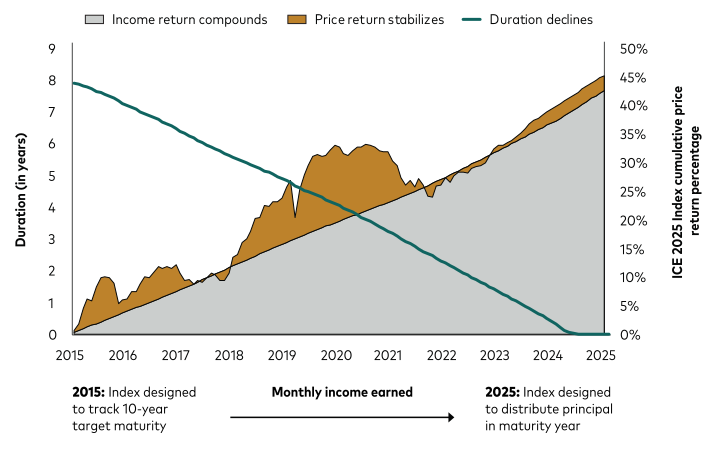
Note: The ICE 2025 Maturity US Corporate Constrained Index is part of the ICE 20XX Maturity US Corporate Constrained Index series.
Source: Intercontinental Exchange, Inc, from December 31, 2015, through December 31, 2025.
Past performance is no guarantee of future returns. The performance of an index is not an exact representation of any particular investment, as you cannot invest directly in an index.
The launch of the 10 BondBuilder TMEs means advisors have access to efficient, versatile tools for customizing client portfolios. Clients benefit from a product that’s designed to provide predictable monthly income distributions over the life of the TME, return of principal when the TME matures, and daily liquidity to adjust portfolios as needed.
TMEs can experience less volatility than a single bond since they’re comprised of a diverse portfolio of bonds, which lowers default risk and increases return potential.
Your practice can benefit because TMEs can potentially help you source liquidity if your preexisting approaches need adjustment, saving you time for serving clients in higher-value ways.
Why investment-grade corporate bonds
Strong credit quality and historically low default rates of IG corporate bonds support the potential for regular monthly income.
This makes them well-suited for bond ladders when the goal is often to address specific time horizons, liquidity needs, or future liabilities.
Given the goals-based purpose of bond-laddering strategies, an index approach using IG corporate bonds can make more sense than an active strategy by reducing costs given the reduced portfolio turnover associated with indexing.
Monthly distributions
Similar to traditional bond ETFs, TMEs distribute monthly income that reflects the TMEs’ underlying bond coupon payments and other cash-flow-driven events. Investors can elect to reinvest these dividends automatically or receive the distribution payments.
Lifecycle of a TME: The final year
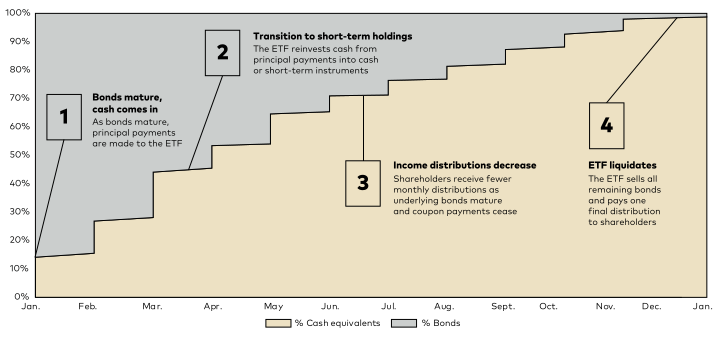
1- Defined maturity date when the product is designed to return principal
Each TME holds bonds that mature or are expected to be called in the fund’s final year of life. Proceeds of bonds that have matured during the final year of the TME’s life are reinvested in cash or cash equivalents. Once all bonds in the portfolio have matured, each TME liquidates and distributes a final payment that reflects the fund’s net asset value (NAV).
2 - Declining interest rate sensitivity
Similar to an individual bond, the average duration of a TME declines over the life of the fund, which reduces the interest rate risk of your investment as maturity approaches.
This results in lower volatility in TMEs compared to traditional bond ETFs which have a set duration and, unlike TMEs, no defined maturity.
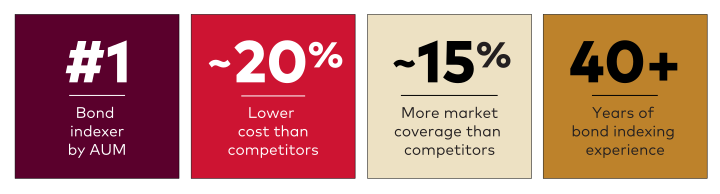
Notes: The #1 bond indexing provider by assets under management of $1.47 trillion, based on Vanguard calculations using data from Morningstar, Inc., as of December 31, 2025. Lower cost than competitors claim based on Vanguard analysis of Morningstar data, as of February 28, 2026. Claim of market coverage of about 15% more relates to TME indexes competitors employ and is based on data from Intercontinental Exchange, Inc., as of December 31, 2025.
Sources: Vanguard and Morningstar.
With an estimated expense ratio of 0.08%, the BondBuilder TMEs are anticipated to be priced 20% lower than competitor suites of products.[2] This low-cost access, plus Vanguard’s 40-plus years of indexing expertise and its global team of fixed income experts, are cornerstones of our institutional quality bond funds.[3]
| Ticker | BondBuilder ETF Name | Expense Ratio |
|---|---|---|
| VBCA | Vanguard Target Maturity 2027 Corporate Bond ETF | 0.08% |
| VBCB | Vanguard Target Maturity 2028 Corporate Bond ETF | 0.08% |
| VBCC | Vanguard Target Maturity 2029 Corporate Bond ETF | 0.08% |
| VBCD | Vanguard Target Maturity 2030 Corporate Bond ETF | 0.08% |
| VBCE | Vanguard Target Maturity 2031 Corporate Bond ETF | 0.08% |
| VBCF | Vanguard Target Maturity 2032 Corporate Bond ETF | 0.08% |
| VBCG | Vanguard Target Maturity 2033 Corporate Bond ETF | 0.08% |
| VBCH | Vanguard Target Maturity 2034 Corporate Bond ETF | 0.08% |
| VBCI | Vanguard Target Maturity 2035 Corporate Bond ETF | 0.08% |
| VBCJ | Vanguard Target Maturity 2036 Corporate Bond ETF | 0.08% |
Notes:
For more information about Vanguard funds or Vanguard ETFs, visit advisors.vanguard.com or call 800-997-2798 to obtain a prospectus or, if available, a summary prospectus. Investment objectives, risks, charges, expenses, and other important information are contained in the prospectus; read and consider it carefully before investing.
Vanguard ETF Shares are not redeemable with the issuing Fund other than in very large aggregations worth millions of dollars. Instead, investors must buy and sell Vanguard ETF Shares in the secondary market and hold those shares in a brokerage account. In doing so, the investor may incur brokerage commissions and may pay more than net asset value when buying and receive less than net asset value when selling.
All investing is subject to risk, including possible loss of principal. Diversification does not ensure a profit or protect against a loss.
Bond funds are subject to interest rate risk, which is the chance bond prices overall will decline because of rising interest rates, and credit risk, which is the chance a bond issuer will fail to pay interest and principal in a timely manner or that negative perceptions of the issuer’s ability to make such payments will cause the price of that bond to decline.
The Target Maturity ETFs (TMEs) are term funds that will liquidate in December of the year in each TME’s name. During the 12 months prior to the planned liquidation date, each TME’s yield generally will tend to move toward prevailing money market rates.
The sale of the VBCA, VBCB, VBCC, VBCD, VBCE, VBCF, VBCG, VBCH, VBCI and VBCJ qualifies as a private placement pursuant to section 2 of Uruguayan law 18.627. Vanguard represents and agrees that it has not offered or sold, and will not offer or sell, any VBCA, VBCB, VBCC, VBCD, VBCE, VBCF, VBCG, VBCH, VBCI and VBCJ to the public in Uruguay, except in circumstances which do not constitute a public offering or distribution under Uruguayan laws and regulations. Neither the VBCA, VBCB, VBCC, VBCD, VBCE, VBCF, VBCG, VBCH, VBCI and VBCJ nor issuer are or will be registered with the Superintendency of Financial Services of the Central Bank of Uruguay to be publicly offered in Uruguay.
The VBCA, VBCB, VBCC, VBCD, VBCE, VBCF, VBCG, VBCH, VBCI and VBCJ correspond to investment funds that are not investment funds regulated by Uruguayan law 16,774 dated 27 September 1996, as amended.
Data provided by Morningstar is property of Morningstar and Morningstar’s data providers and it should therefore not be copied or distributed. Morningstar and its data providers are not responsible for any certification or representation with respect to data validity, certainty, or accuracy and are therefore not responsible for any losses derived from the use of such information.
Vanguard Mexico is not responsible for and does not prepare, edit, or endorse the content, advertising, products, or other materials on or available from any website owned or operated by a third party that may be linked to this email/document via hyperlink. The fact that Vanguard Mexico has provided a link to a third party's website does not constitute an implicit or explicit endorsement, authorization, sponsorship, or affiliation by Vanguard with respect to such website, its content, its owners, providers, or services. You shall use any such third-party content at your own risk and Vanguard Mexico is not liable for any loss or damage that you may suffer by using third party websites or any content, advertising, products, or other materials in connection therewith.
[1] The expense ratio information shown reflects estimated amounts for the current fiscal year.
[2] Morningstar, Inc., as of December 31, 2025.
[3] “Institutional quality” in this context is meant to convey a level of professional rigor and expertise combined with low costs.