Saver or investor? Why the answer matters for women
Most women feel confident in their ability to save money, but many could benefit from opportunities to earn more on those savings, according to a new Vanguard national survey.

Most women feel confident in their ability to save money, but many could benefit from opportunities to earn more on those savings, according to a new Vanguard national survey.
Este artículo está disponible sólo en inglés.
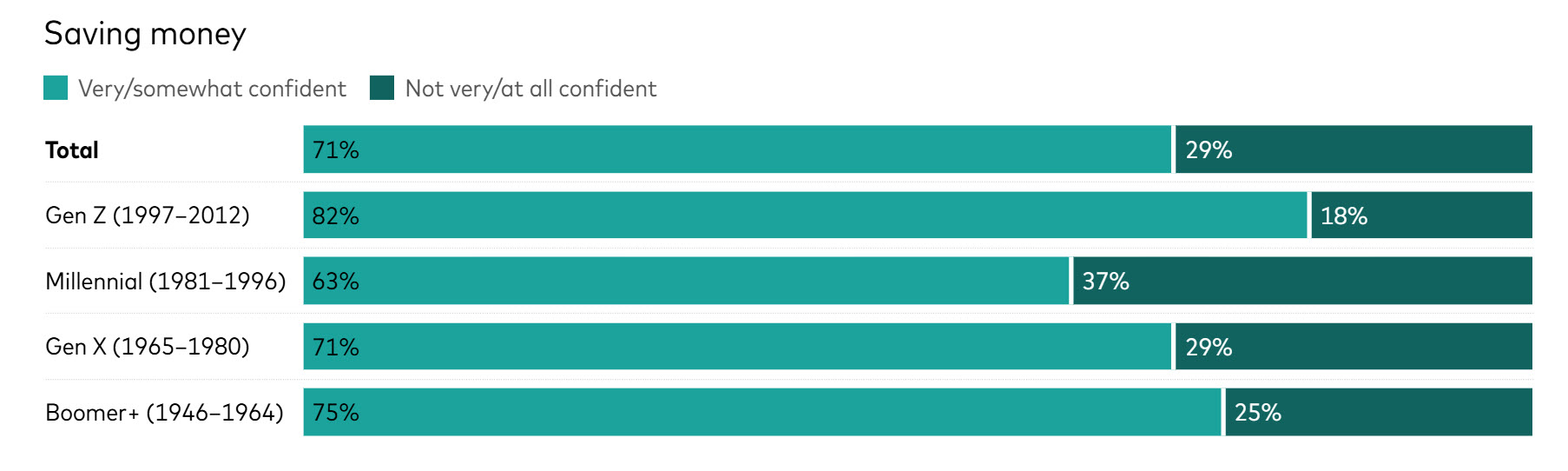
When we asked over 1,000 women across the country to describe their level of confidence in saving money, 71% said they were very or somewhat confident. The results varied by generation: Gen Z expressed the highest levels of confidence at 82%, and Millennials the lowest at 63%.
Notes: The findings are based on a nationally representative survey of U.S. women conducted in April 2026. The survey was fielded by Big Village among a sample of 1,007 women age 18 and older. Quota sampling is used to collect a nationwide sample of respondents who are weighted by age, region, race/ethnicity, and education to mirror the demographical composition of the U.S. population using Current Population Survey proportions.
Source: Vanguard.
Choosing to save is smart. One way to improve that choice is to save in a high-yield account, but many women don’t. In our survey, more than 70% of women said they either earn less than 3% on their savings or don’t know what percentage interest they’re earning.
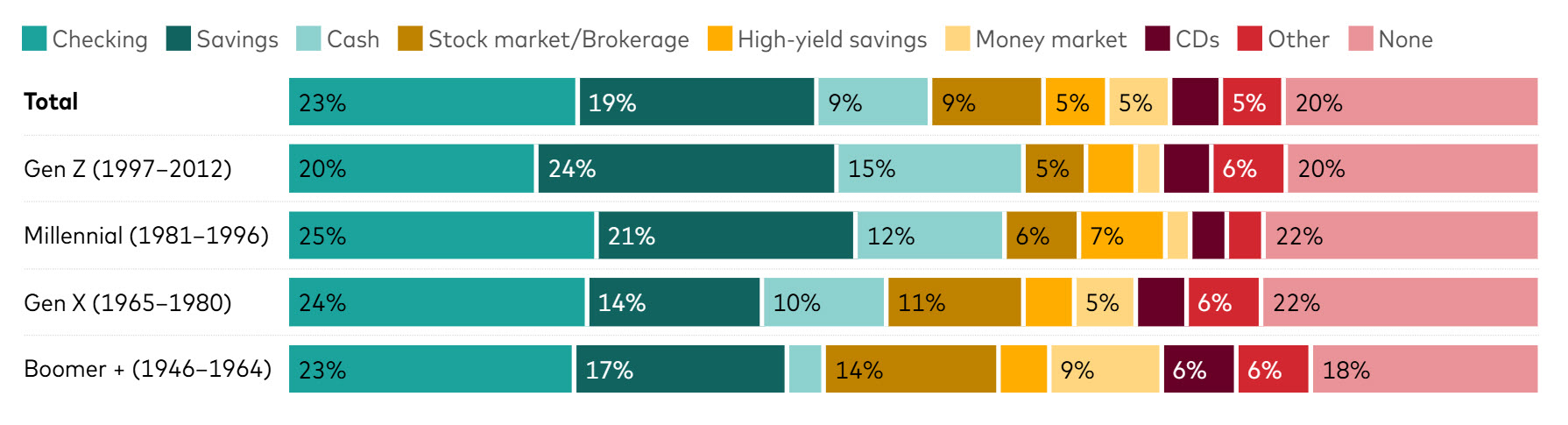
Survey participants also said they keep the majority of their nonretirement savings in traditional bank checking or savings accounts or physical cash, which all tend to earn little or no interest.
Checking accounts, savings accounts, and cash dominate women’s nonretirement savings
Notes: The findings are based on a nationally representative survey of U.S. women conducted in April 2026. The survey was fielded by Big Village among a sample of 1,007 U.S. women 18 years of age and older. Quota sampling is used to collect a nationwide sample of respondents who are weighted by age, region, race/ethnicity, and education to mirror the demographical composition of the U.S. population using Current Population Survey proportions.
Source: Vanguard.
Leaving money in low-yielding bank accounts comes at a high cost. The average bank savings account yield is just 0.38%.1 Many high-yield savings and money market options pay well above 3%. That difference matters: Inflation, which is currently at 3.8%, can quickly erode the value of savings. Higher-yielding accounts can help maintain purchasing power as prices rise.
About 65% of women in our survey cited safety and the ability to access money as reasons for keeping funds in traditional bank savings or checking accounts or in physical cash, even though higher-yielding accounts can offer similar levels of security and ease of access. Comparison shoppers should ask about available FDIC insurance and how the account allows them to access their savings.
“A simple first step toward earning more is to compare the rate you are earning on your current account with those available elsewhere,” said Sonia Fraher, head of cash management at Vanguard. “Everyone can make smart moves with their money, and getting more out of your savings is a great place to start.”
When the survey asked about investing, women’s confidence levels dropped dramatically. More than half of women (52%) said they felt not very or not at all confident in themselves as investors.
It’s a surprising finding given that many women already are investors through their 401(k) plans. Also, studies show that women are good investors. They outperform men with similar incomes in contributing to and staying the course on their investments in workplace retirement plans.2 And women are more likely to maintain discipline during stock-market volatility, which can increase their chances of investment success.
“The issue is not a lack of ability. When women invest, they tend to make wise, disciplined choices,” said Fiona Greig, global head of investor research and policy at Vanguard. “Even if women don't identify as investors, they make for great ones.”
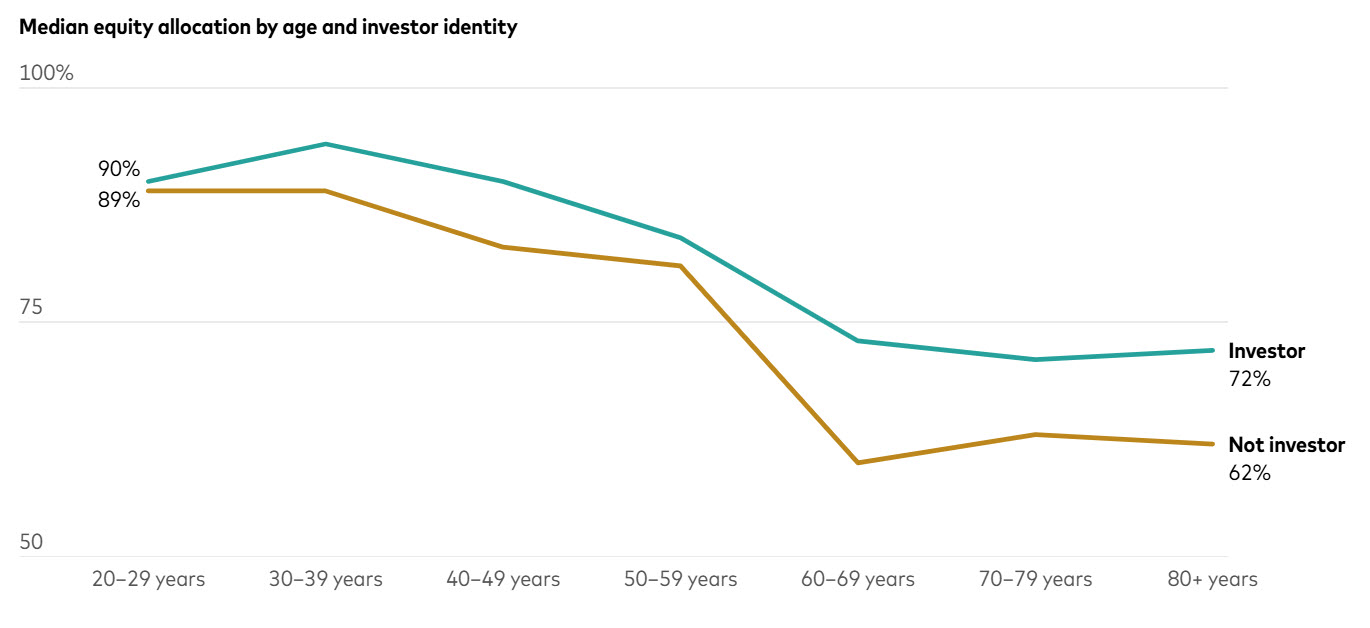
Despite women’s strong investment choices, their tendency to see themselves as savers or budgeters may harm their long-term returns. In previous research on Vanguard clients—both men and women—we found that people who identify as investors tend to hold more equities (stocks) in their portfolios compared with self-identified non-investors.
Self-identified investors hold more equities than non-investors
Notes: The findings were based on analysis of approximately 3,000 Vanguard individual investors’ asset allocations as of December 31, 2024, combined with their survey responses to the question “Do you consider yourself an investor?”
Source: Vanguard.
Portfolios with higher equity allocations tend to outperform those with less. For instance, an allocation of 60% stocks and 40% bonds has historically generated a 9.1% average annualized return, compared with 9.8% for a portfolio of 70% stocks and 30% bonds. This difference translates to roughly 17% less wealth after 30 years of investing.3
“The investor identity gap and corresponding equity gap may very well lead to a wealth gap in the long run,” Vanguard investment strategy analyst Malena de la Fuente said. “Even a 10% deficit in equity allocation can translate to significant opportunity costs over several decades.”
Of course, the appropriate equity allocation varies from person to person. Investors should always choose portfolios that match their goals, time horizons, and risk tolerance. But it is essential to gain the confidence and knowledge required to make investment decisions—including how much equity to allocate—that align with individual needs.
Women are in a strong position to get more out of their savings and investments. The next step is putting that financial control to work in ways that can build long-term wealth by:
opening up conversations about investing with trusted friends, colleagues, and family members to help destigmatize the topic and make it feel less overwhelming;
using online resources and tools that can help savers and investors learn more and get started on their journeys;
treating investing as an extension of saving—a habit built through regular automatic contributions so that money works harder over time;
seeking additional support from a professional financial advisor who can tailor investments to individual goals and keep investors on a path to achieving them; and
taking advantage of education that employers provide for their retirement plans and even asking for additional programs, since many women learn about investing for the first time at work.
Fortunately, saving and investing success need not depend on whether women consider themselves savers, investors, or anything else. What matters more is continuing to learn, building confidence, and making financial decisions that support long-term financial well-being.
Notes:
All investing is subject to risk.
Past performance is no guarantee of future results.
Be aware that fluctuations in the financial markets and other factors may cause declines in the value of your account. There is no guarantee that any particular asset allocation or mix of funds will meet your investment objectives or provide you with a given level of income.
Bloomberg® and Bloomberg Indexes mentioned herein are service marks of Bloomberg Finance LP and its affiliates, including Bloomberg Index Services Limited (“BISL”), the administrator of the index (collectively, “Bloomberg”) and have been licensed for use for certain purposes by Vanguard. Bloomberg is not affiliated with Vanguard and Bloomberg does not approve, endorse, review, or recommend the Financial Products included in this document. Bloomberg does not guarantee the timeliness, accurateness or completeness of any data or information related to the Financial
Products included in this document Data provided by Morningstar is property of Morningstar and Morningstar’s data providers and it should therefore not be copied or distributed. Morningstar and its data providers are not responsible for any certification or representation with respect to data validity, certainty, or accuracy and are therefore not responsible for any losses derived from the use of such information.