Este artículo está disponible sólo en inglés.
Active strategies offer the prospect of better long-term returns and wealth creation than index funds, provided that costs are reasonable and manager talent is high. But even the best-performing funds and managers experience stretches of underperformance—sometimes for years—as their investing styles fall in and out of favor.

Combining actively managed funds and ETFs with complementary, diversifying style exposures can help reduce the frequency and magnitude of these drawdowns at the portfolio level. This approach may enhance risk-adjusted returns over time and provide a smoother ride that’s easier for investors to stick with. 

It’s not as simple as style boxes

Combining active products isn’t as easy as picking a fund from the value, core, and growth style boxes and allocating to each one equally. This is particularly true today, given the highly concentrated U.S. stock market, which has been a headwind for most active managers.  

At Vanguard, we draw on nearly 40 years of experience blending complementary active strategies within our multimanager funds, such as Vanguard Windsor™ Fund or Vanguard International Growth Fund. These funds combine portfolios from leading active managers into a single mutual fund. The portfolio construction exercise behind these funds can serve as a guide for investors who want to build an active portfolio. As the number of active ETFs continues to grow, investors face exciting opportunities and new challenges. We’re sharing this guidance to help investors cut through the complexity, make informed choices, and construct an active equity portfolio that supports their long-term goals.

Building an active portfolio: Key steps

Define your intended risk profile. Combining active managers requires balancing your confidence in each manager with their role in the portfolio and their contribution to the overall intended risk-reward profile. Do you want to tilt the portfolio toward certain factors (for example, value) that you believe will outperform over time? Do you want to take more risk than the market or less?  

Know the strategies. It’s essential to understand the investment approaches, style factor biases, and performance patterns of the specific active strategies you are considering.  

Test a variety of allocations. Once you establish those foundations, test different allocations to analyze the exposures within the total portfolio and compare that to the portfolio benchmark. This step helps ensure that unintended risk factors don’t swamp the stock-picking skills that presumably drew you to the managers in the first place.  

An example using Vanguard ETFs

Here are three ETFs that together illustrate one way an investor could build an active equity portfolio: 

  • Vanguard Wellington™ U.S. Growth Active ETF (VUSG) provides concentrated high-growth exposure by targeting innovative companies that have the potential to deliver long-term growth regardless of the economic cycle.

  • Vanguard Wellington U.S. Value Active ETF (VUSV) employs an opportunistic, contrarian value strategy.

  • Vanguard Wellington Dividend Growth Active ETF (VDIG) offers defensive exposure by targeting high-quality companies that can grow their dividends over time.

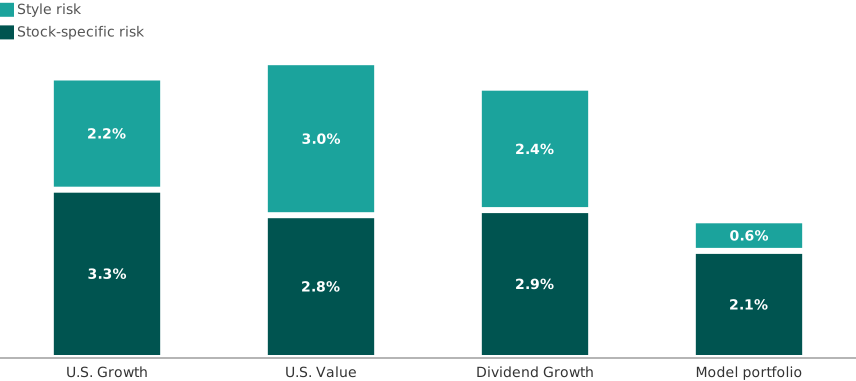
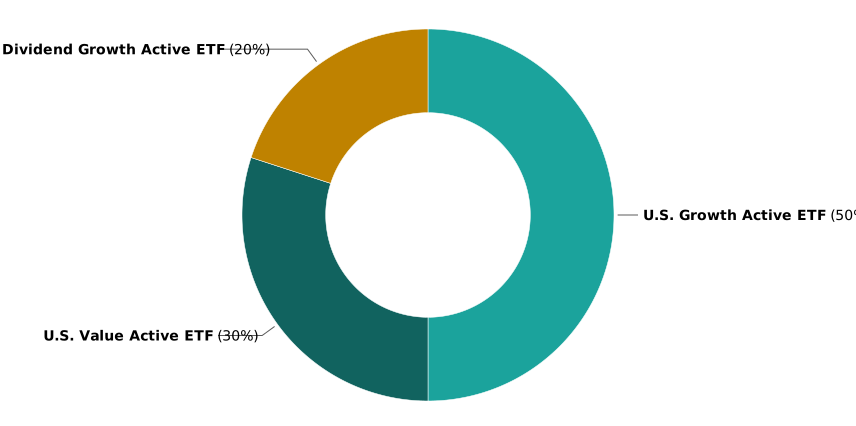
For a portfolio designed to maintain a balanced profile relative to a U.S. core benchmark, our analysis suggests an allocation of 50% VUSG, 30% VUSV, and 20% VDIG. This mix is most effective at maximizing stock-specific risk and minimizing style risk, thus allowing the managers’ stock-picking skills to shine through. 

The overweight to VUSG isn’t based on a belief that growth stocks will outperform. Given the concentration of mega-cap tech stocks in the U.S. market (the Magnificent Seven), an equal-weight approach would create a structural underweight allocation to this cohort because of the defensive and value-oriented nature of VUSV and VDIG. The 50/30/20 portfolio helps avoid that underweight while maintaining notable relative differences within the cohort driven by the stock-level positions in VUSG.

A style-balanced portfolio lets stock selection drive alpha

Illustrative model allocations

Style Balanced portfolio

https://www.datawrapper.de/_/OR0eM/

Compared with the individual ETFs, the model portfolio reduces tracking error and neutralizes style risk more than stock-specific risk, thus keeping active risk focused on security selection
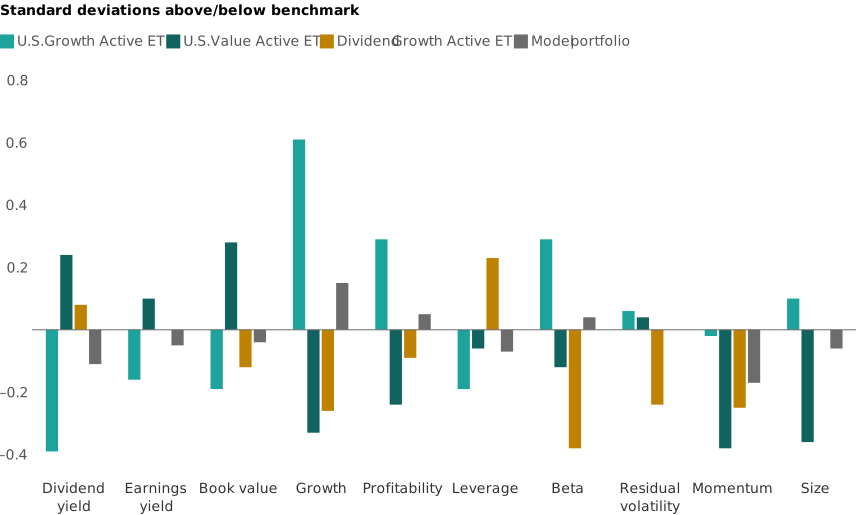
Style factor tilts versus Russell 1000 Index
Standard deviations

https://www.datawrapper.de/_/lGOU4/

Projected tracking error versus Russell 1000 Index
Projected tracking error

https://www.datawrapper.de/_/12X7l/

Notes: The illustrative model portfolio is 50% Vanguard Wellington U.S. Growth Active ETF (VUSG), 30% Vanguard Wellington U.S. Value Active ETF (VUSV), and 20% Vanguard Wellington Dividend Growth Active ETF (VDIG).

Sources: Vanguard, using Axioma data, as of September 30, 2025.

Customizing the portfolio for your goals 

Of course, your goals might be different. For example, if you want a more defensive portfolio, it may make sense to increase your exposure to VDIG over VUSG and VUSV. It’s all a question of tradeoffs.  

We believe that, for investors who have already gravitated toward incorporating active ETFs as key components in their portfolios, it’s worth finding a baseline allocation that maximizes stock-selection alpha by minimizing other relative risk factors. From that baseline, you can adjust depending on your convictions and goals. 


Important information

For more information about Vanguard funds or Vanguard ETFs, visit advisors.vanguard.com to obtain a prospectus or, if available, a summary prospectus. Investment objectives, risks, charges, expenses, and other important information are contained in the prospectus; read and consider it carefully before investing. 

Vanguard ETF Shares are not redeemable with the issuing fund other than in very large aggregations worth millions of dollars. Instead, investors must buy and sell Vanguard ETF Shares in the secondary market and hold those shares in a brokerage account. In doing so, the investor may incur brokerage commissions and may pay more than net asset value when buying and receive less than net asset value when selling.

All investing is subject to risk, including possible loss of principal. 

Vanguard Mexico is not responsible for and does not prepare, edit, or endorse the content, advertising, products, or other materials on or available from any website owned or operated by a third party that may be linked to this email/document via hyperlink.  The fact that Vanguard Mexico has provided a link to a third party's website does not constitute an implicit or explicit endorsement, authorization, sponsorship, or affiliation by Vanguard with respect to such website, its content, its owners, providers, or services.  You shall use any such third-party content at your own risk and Vanguard Mexico is not liable for any loss or damage that you may suffer by using third party websites or any content, advertising, products, or other materials in connection therewith.

The sale of the VUSV, VUSG and/or the VDIG qualifies as a private placement pursuant to section 2 of Uruguayan law 18.627. Vanguard represents and agrees that it has not offered or sold, and will not offer or sell, any VUSV, VUSG and/or the VDIG to the public in Uruguay, except in circumstances which do not constitute a public offering or distribution under Uruguayan laws and regulations. Neither the VUSV, VUSG and/or the VDIG nor issuer are or will be registered with the Superintendency of Financial Services of the Central Bank of Uruguay to be publicly offered in Uruguay.”

The VUSV, VUSG and/or the VDIG correspond to investment funds that are not investment funds regulated by Uruguayan law 16,774 dated 27 September 1996, as amended.