Portfolio completion
Learn about strategic and tactical uses for ETFs, including asset and sub-asset allocation, portfolio completion, cash equitization and more.
Portfolio completion
Portfolio completion may be used strategically or tactically to fill a gap in a portfolio.
For example, an investor may have little or no exposure to certain asset classes, market segments or sectors. Wholesale rebalancing to diversify the portfolio or transitioning into a model portfolio may not be possible because of trading restrictions or other issues.
In these cases, ETFs can be used to fill gaps until the portfolio can be rebalanced to the desired allocation. In the illustration, a value ETF fills a gap and increases the diversification of a portfolio that's heavily weighted toward growth stocks.
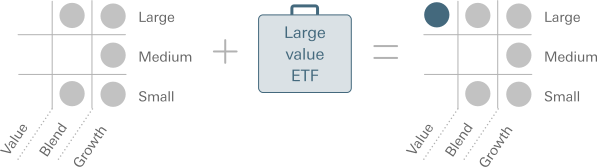
Source: Vanguard. This hypothetical investment or portfolio strategy is shown for illustrative purposes only and shall not be construed as a recommendation to buy or sell any security or financial instrument, or an offer or recommendation to participate in any particular trading or investment strategy.
Point to consider
Greater diversification introduces the possibility of underperformance relative to a concentrated portfolio, but it also means less risk.
ETF fundamentals
Basics
Learn the basics of ETFs, including their history, how they compare to mutual funds, what types are available and more.
Indexing
Indexing, how ETFs are indexed, the differences between excess return and tracking error, and more.
Trading
Learn how ETFs trade, where they get liquidity, common order types, how premiums and discounts work and more.