Active/passive combinations
Learn about strategic and tactical uses for ETFs, including asset and sub-asset allocation, portfolio completion, cash equitization and more.
Active/passive combinations
Actively managed investments offer an opportunity for outperformance, but they also bring greater relative risk and unpredictability.
Low-cost passively managed investments typically reflect the risk and return characteristics of a given market segment but do not offer the opportunity for outperformance. Combining low-cost active funds and ETFs with index-based ETFs can achieve a balance between the two approaches.
Core-satellite approach
One way to do this is with a "core-satellite" strategy that employs indexing at the core of a portfolio and actively managed funds as satellites. This idea recognizes the differences between indexing and active management and combines the best aspects of both approaches.
The index core provides a risk-controlled, low-cost way to capture market returns (beta) over the long-term, while the actively managed satellites provide an opportunity for market outperformance (alpha).
| Active approach | Index approach |
|---|---|
|
|
Core-satellite methodology
The conventional view of core-satellite methodology (Figure 1) suggests that it’s prudent to use index funds for markets that are deemed efficient, such as large-cap stocks. This view holds that actively managed funds make more sense to use in areas of the market that are considered to be inefficient, such as small-cap or emerging market stocks. The thinking here is that active managers are more likely to succeed in these areas.
Figure 1

Source: Vanguard. This hypothetical investment or portfolio strategy is shown for illustrative purposes only and shall not be construed as a recommendation to buy or sell any security or financial instrument, or an offer or recommendation to participate in any particular trading or investment strategy.
An alternative view of core-satellite investing (Figure 2) suggests that indexing is a powerful investment strategy in all market segments. As a result, the active/index decision should be predicated on an investor’s ability to identify low-cost, talented managers, not on the indiscriminate selection of active managers in apparently inefficient market areas. This view holds that skill in selecting active managers drives the success of a core-satellite portfolio.
Figure 2
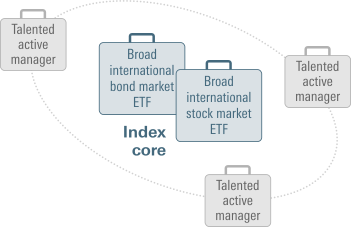
Source: Vanguard. This hypothetical investment or portfolio strategy is shown for illustrative purposes only and shall not be construed as a recommendation to buy or sell any security or financial instrument, or an offer or recommendation to participate in any particular trading or investment strategy.
Points to consider
- There is no guarantee that a combined active/passive approach will be less risky than an all-active or all-index approach and will achieve comparable returns.
- Whether they choose active or passive funds, investors should consider funds that have low overall costs to increase the probability of long-term success. Costs directly detract from investment returns.
ETF fundamentals
Basics
Learn the basics of ETFs, including their history, how they compare to mutual funds, what types are available and more.
Indexing
Indexing, how ETFs are indexed, the differences between excess return and tracking error, and more.
Trading
Learn how ETFs trade, where they get liquidity, common order types, how premiums and discounts work and more.