50 years. 50 facts. Indexing since 1976
15 minute read
Vanguard insights

50 years. 50 facts. Indexing since 1976

Index investing was for a long time synonymous with tracking the S&P 500, “America’s index.” But as the golden anniversary of index fund investing approaches, the strategy is widely available across and within asset classes. Its appeal is evident: Indexing is an easy-to-understand, cost-effective strategy that can offer diversification, tax efficiency, and consistent performance relative to the results of the market.

Foundations of index fund investing 

1. When John C. Bogle launched Vanguard 500 Index Fund on August 31, 1976, as First Index Investment Trust, he gave individual investors access to a strategy previously available only to institutional investors. The first index fund for individual investors embodied the Vanguard founder’s belief that most investors are better served by owning the whole stock market, at low cost, rather than trying to beat it.  

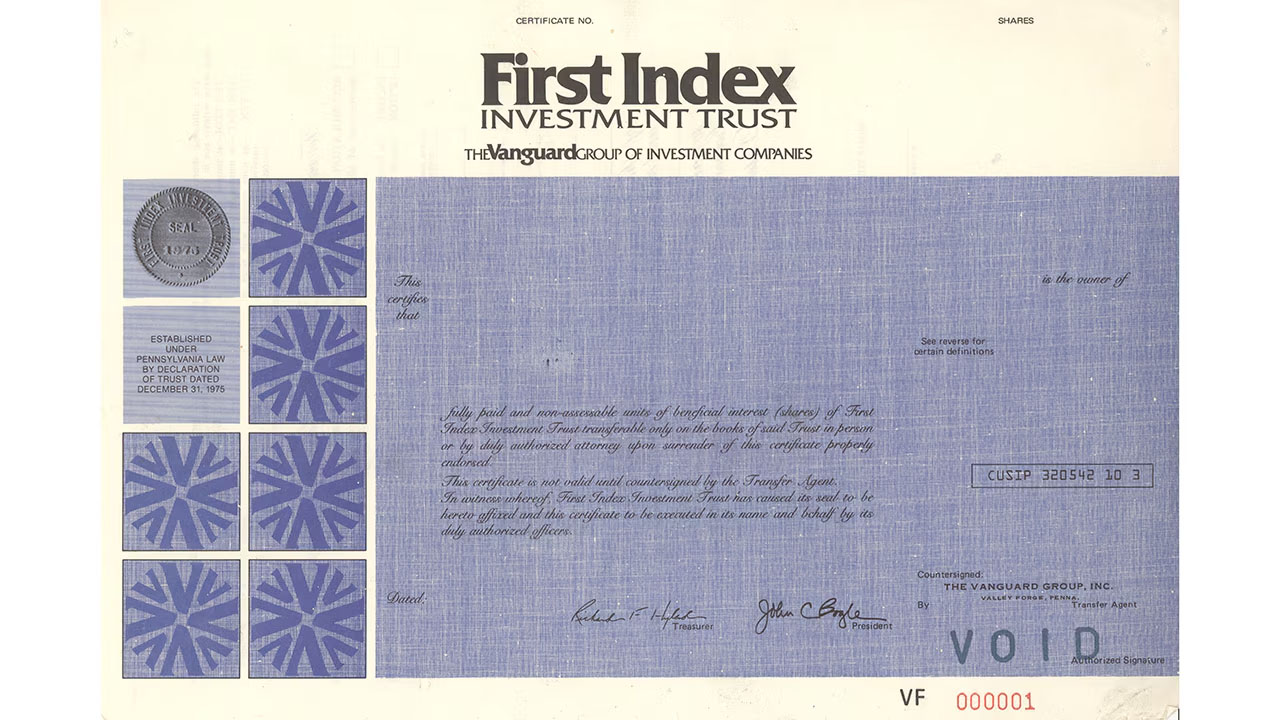
2. Mr. Bogle hoped to raise $50–150 million in initial underwriting to launch Vanguard First Index Investment Trust. The offering raised a little more than $11 million—“an abject failure,” he later put it, in his characteristically blunt style. But what began as an experiment—“Bogle’s Folly,” to some—eventually became a default investment approach for millions.1

Share certificate for the first index mutual fund, later renamed Vanguard 500 Index Fund.

Share certificate for the first index mutual fund, later renamed Vanguard 500 Index Fund.

3.A few months after the launch of First Index Investment Trust, an article in an investment professionals’ journal opened as follows: “An investor seeking expert opinion on index funds might well be confused by what he hears. One conclusion, usually expressed with considerable feeling, is that index funds are a ‘cop-out’ and a fad that will soon disappear. Apparently only a very small minority hold the opposite point of view. They consider index funds the wave of the future ….”2

4.Jan M. Twardowski first led the portfolio management effort. In 1977, shortly after the First Index Investment Trust launched, a reporter for The New York Times wrote that Mr. Twardowski felt “that the fund’s ‘very low’ total operating costs ... will begin to prove more popular with investors.”3

5.Academic support for the strategy preceded the first index-tracking portfolios for institutional investors and Vanguard’s offering for individual investors. In 1973, one such supporter, Princeton University professor Burton S. Malkiel, suggested a new investment instrument: “a no-load, minimum-management-fee mutual fund that simply buys the hundreds of stocks making up the market averages and does no trading (of securities) …. Fund spokesmen are quick to point out, ‘you can’t buy the averages.’ It’s about time the public could.”4

6.In his 1951 undergraduate thesis for Princeton University, Mr. Bogle highlighted the crucial role of costs in the long-term returns earned by investors. He identified costs as a drag on the performance of the industry, which was then entirely actively managed.

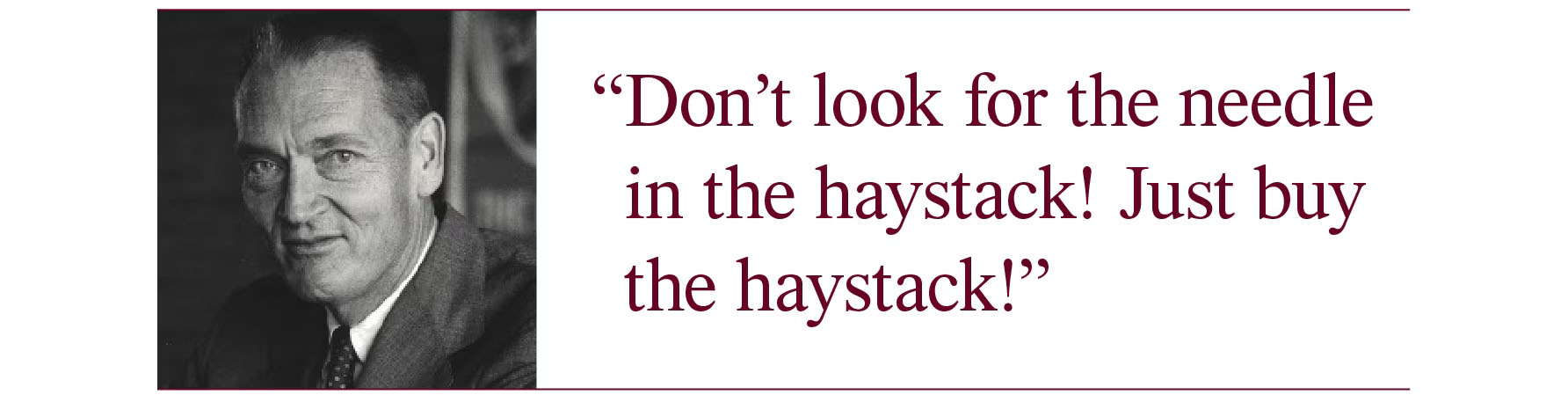
7.In the years following 1976, Mr. Bogle famously—and often—advised investors .... 

 

Vanguard founder John C. Bogle, pictured in 1989.

Vanguard founder John C. Bogle, pictured in 1989.

The important role of index investing 

8. Indexing is integral to U.S. retirement savings. As of year-end 2024, 96% of defined-contribution retirement plans offered target-date funds, which rely on indexing as a core building block.v 

9. 529 educational savings plans in the United States also rely to a meaningful degree on index funds, according to data from Morningstar.6

10. Index funds can help to enhance market stability in times of market stress. Investors in index-based strategies tend to stay invested during periods of volatility, providing a reliable source of capital. 

11. The diversity of index strategies allows investors to move capital across wide swaths of the market, enabling price discovery beyond a narrow group of stocks. That’s because different index funds hold distinct sets of securities, and reallocating assets among them leads to trades that contribute to price formation—even though the index fund investor isn’t making active stock picks.

12. Market data show that volatility and liquidity patterns have remained stable as index investing has grown, indicating that index funds coexist with—and support—well-functioning, dynamic capital markets.7

  1. Vanguard’s founder recounted the initial fundraising for First Index Investment Trust—and indexing’s rise over the next 35 years—in a September 2011 guest column for The Wall Street Journal. (Subscription required.)
  2.  Walter R. Good, Robert Ferguson, and Jack Treynor. An Investor’s Guide to the Index Fund Controversy. Financial Analysts Journal, 1976, 32(6): 27–36. Introduction available at: https://www.tandfonline.com/doi/abs/10.2469/faj.v32.n6.27.
  3.  Phalon, Richard. Beating the Market or “Indexing” It? The New York Times, 1977. https://www.nytimes.com/1977/03/26/archives/personal-investing-beating-the-market-or-indexing-it.html.
  4.  This quote is from a 1997 Vanguard publication, The First Index Mutual Fund: A History of Vanguard Index Trust and the Vanguard Index Strategy. Vanguard founder John C. Bogle cites Malkiel’s call for an index fund in the latter’s 1973 book, A Random Walk Down Wall Street (W.W. Norton). Note that, for about the first six months of its existence, First Index Investment Trust was sold via brokers, and shareholders had to pay sales loads or commissions to purchase shares. All Vanguard funds adopted a no-load distribution strategy in early 1977. Also in 1977, Malkiel joined the boards of directors of the Vanguard funds.
  5.  Our source is the Vanguard report How America Saves 2025, available at https://workplace.vanguard.com/content/dam/inst/iig-transformation/insights/pdf/2025/has/2025_How_America_Saves.pdf.
  6.  Source: Morningstar research report, 2025 529 Savings Plan Landscape, August 2025. See, in particular, page 6. 
  7.  James J. Rowley, Jr., Stephen Lawrence, and Ollie Ryder-Green. Setting the Record Straight: The Truths About Index Fund Investing. Vanguard, 2025. https://corporate.vanguard.com/content/dam/corp/research/pdf/setting_the_record_straight_the_truths_about_index_fund_investing.pdf.
  8.  Approximate sector and industry counts reflect Global Industry Classification Standards.
  9.  For an illustration of the construction of actively oriented portfolios by index fund investors, see Figure 4 in the Vanguard publication Setting the Record Straight: The Truths About Index Fund Investing. See also the Vanguard article Beyond Beta: Charting the Evolution of Index Investing, (Rowley, Jr., and Ryder-Green, February 2026), available at https://corporate.vanguard.com/cont ent/corporatesite/us/en/corp/articles/beyond-beta-charting-evolution-index-investing.html.
  10. Expense ratios are asset-weighted averages, reflecting U.S.-domiciled mutual funds and ETFs, as reported in the Morningstar 2024 U.S. Fund Fee Study. See Fund Fees Are Still Declining, But Not as Quickly as They Once Were (Zacharay Evens, May 2025), available at https://www.morningstar.com/financial-advisors/fund-fees-are-still-declining-not-quickly-they-once-were.
  11. Source: Vanguard calculations, based on data from Bloomberg, as of November 30, 2025.
  12. For an illustration of the relationship between fund turnover and after-tax performance, see Figure 6 in the Vanguard research paper Considerations for Index Fund Investing (Lawrence, Patterson, and Ertl, 2024), available at https://corporate.vanguard.com/content/dam/corp/research/pdf/considerations_for_index_fund_investing.pdf. 
  13. For an illustration of the relative performance predictability of index funds, see Figure 2 in the Vanguard research paper Considerations for Index Fund Investing.
  14. Roughly 5% of U.S. mutual funds disappear each year through mergers and liquidations. Sources: Vanguard calculations, based on data from the CRSP Survivor-Bias-Free US Mutual Fund Database.
  15. The annualized return of VFINX from inception through March 31, 2026, trailed the 11.68% return of the S&P 500 Index by 0.24 percentage points. Standardized performance for periods ended March 31, 2026: 1 year, VFINX 17.64%, S&P 500 Index 17.80%; 5 years, VFINX 11.90%, S&P 500 Index 12.06%; and 10 years, VFINX 14.00%, S&P 500 Index 14.16%. The current VFINX expense ratio is 0.14%. Sources: Vanguard calculations, based on data from Morningstar Direct.
     The performance data shown represent past performance, which is not a guarantee of future results. Investment returns and principal value will fluctuate, so that investors' shares, when sold, may be worth more or less than their original cost. Current performance may be lower or higher than the performance data cited. For performance data current to the most recent month-end, visit our website at https://workplace.vanguard.com/investments/product-details/fund/0040.
  16. Source: Morningstar Direct. For the company’s medalist rating methodology, refer to the notes section below. See also Morningstar’s current assessment of the fund; available at: https://www.morningstar.com/funds/xnas/vfiax/analysis.
  17. Vanguard 500 Index Fund no longer offers Investor Shares (ticker: VFINX)—the original share class, first offered in 1976—to new investors. Following are the fund’s three other share classes, their inception dates, and minimum initial investments: Admiral (VFIAX), November 13, 2000, $3,000; ETF (VOO), September 7, 2010, the cost of a single share (less at brokerage firms that support fractional-share purchases); and Institutional Select (VFFSX), June 24, 2016, $5 billion. Source: Vanguard. 
  18. Investor Shares in Vanguard 500 Index Fund are closed to new investors.
  19. Sumit Roy. U.S. ETFs Pull In a Record $1.49 Trillion in 2025. etf.com, January 2026. https://www.etf.com/sections/monthly-etf-flows/us-etfs-pull-record-149-trillion-2025.
  20. 2024 Annual Report of the Thrift Savings Plan. Federal Retirement Thrift Investment Board, 2025. https://www.frtib.gov/pdf/reading-room/congress/annual/TSP-Annual-Report_2024.pdf.
  21. Jonathan Burton. Investment Titans: Investment Insights from the Minds That Move Wall Street. McGraw-Hill, 2000.
  22. Vanguard calculations, based on data from the U.S. Census Bureau’s Population Division, Annual Estimates of the Resident Population by Single Year of Age and Sex for the United States: April 1, 2020, to July 1, 2024, released June 2025.

Notes:

For more information about Vanguard funds, visit vanguard.com to obtain a prospectus or, if available, a summary prospectus. Investment objectives, risks, charges, expenses, and other important information are contained in the prospectus; read and consider it carefully before investing.

Vanguard ETF Shares are not redeemable with the issuing Fund other than in very large aggregations worth millions of dollars. Instead, investors must buy and sell Vanguard ETF Shares in the secondary market and hold those shares in a brokerage account. In doing so, the investor may incur brokerage commissions and may pay more than net asset value when buying and receive less than net asset value when selling.
All investing is subject to risk, including the possible loss of the money you invest.
Be aware that fluctuations in the financial markets and other factors may cause declines in the value of your account. There is no guarantee that any particular asset allocation or mix of funds will meet your investment objectives or provide you with a given level of income.
Diversification does not ensure a profit or protect against a loss.
Past performance is no guarantee of future returns. The performance of an index is not an exact representation of any particular investment, as you cannot invest directly in an index. 
Investments in bonds are subject to interest rate, credit, and inflation risk.