How Does Your Portfolio Stack Up?
Perspectives in 2025: How advisors in LatAm and the US compare

Perspectives in 2025: How advisors in LatAm and the US compare
Portfolio positioning among Latin American (LATAM) and U.S. advisors during 2025 reflects measured responses to a more volatile macroeconomic environment, shifting policy expectations, and heightened geopolitical and fiscal uncertainty. While both groups remained broadly aligned with long‑term diversification principles, their implementation differed across management style, regional equity exposure, bond duration, credit risk, and fund costs.
LATAM advisors typically implement active views at the asset‑allocation level using passive instruments, selectively incorporating active management—most notably within fixed income—while U.S. advisors displayed a stronger structural preference for active strategies, particularly in bond allocations.
These differences translated into distinct cost profiles, duration positioning, and credit exposure, while maintaining common long‑term portfolio construction themes, such as global diversification outside the U.S. and a strategic tilt toward value over growth.
Across portfolios, management style preferences varied by asset class. LATAM advisors generally favored passive implementation, especially in equities. When active strategies were employed, they were primarily used within fixed income allocations, reflecting a targeted approach to security selection and credit exposure.
As a result, the average fund expense ratio of the portfolio remained relatively contained—approximately 22 basis points—although fixed income sleeves exhibited slightly higher relative costs, driven by the greater use of active strategies.
U.S. advisors, by contrast, exhibit a greater overall reliance on active management, a preference that is most pronounced in fixed income. This inclination reflects both the relatively stronger track record of active managers in outperforming bond benchmarks—compared with their more limited success against equity benchmarks—and advisors’ comfort in outsourcing credit quality and duration decisions to active managers rather than implementing these views themselves through passive strategies.
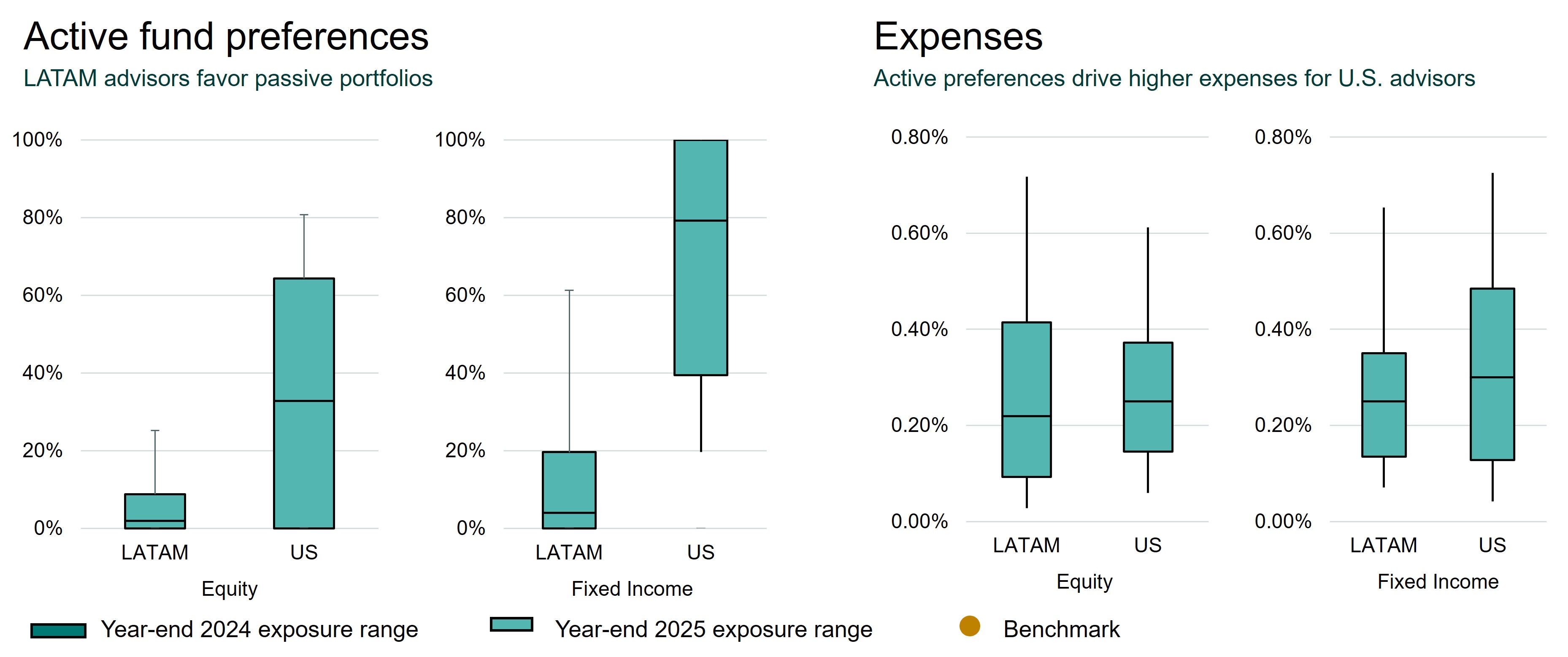
Sources: Vanguard and Morningstar, Inc., as of December 31, 2025. Equity and Fixed Income charts include all observed portfolios in each time period.
Note: For LATAM clients: 480 equity sleeves observed at year-end 2025, with an average of 7 tickers per sleeve. 250 fixed income sleeves observed at year-end 2025, with an average of 4 tickers per sleeve. For US advisors: 1,808 equity sleeves observed at year-end 2025, with an average of 10 tickers per sleeve. 2000 fixed income sleeves observed at year-end 2025, with an average of five tickers per sleeve.
Equity and fixed income charts include all observed portfolios in the time period. Active fund preferences exclude individual stock positions.
Following Liberation Day on April 2, 2025—when the United States announced the first round of tariffs—market volatility increased meaningfully. At the same time, growing concerns around U.S. fiscal sustainability contributed to a reassessment of regional concentration risk.
Against this backdrop, investors began to diversify equity exposure away from the United States, particularly among LATAM advisors. While both LATAM and U.S. advisors continued to maintain a structural preference for U.S. equities, LATAM portfolios reduced their overweight meaningfully over the course of the year.
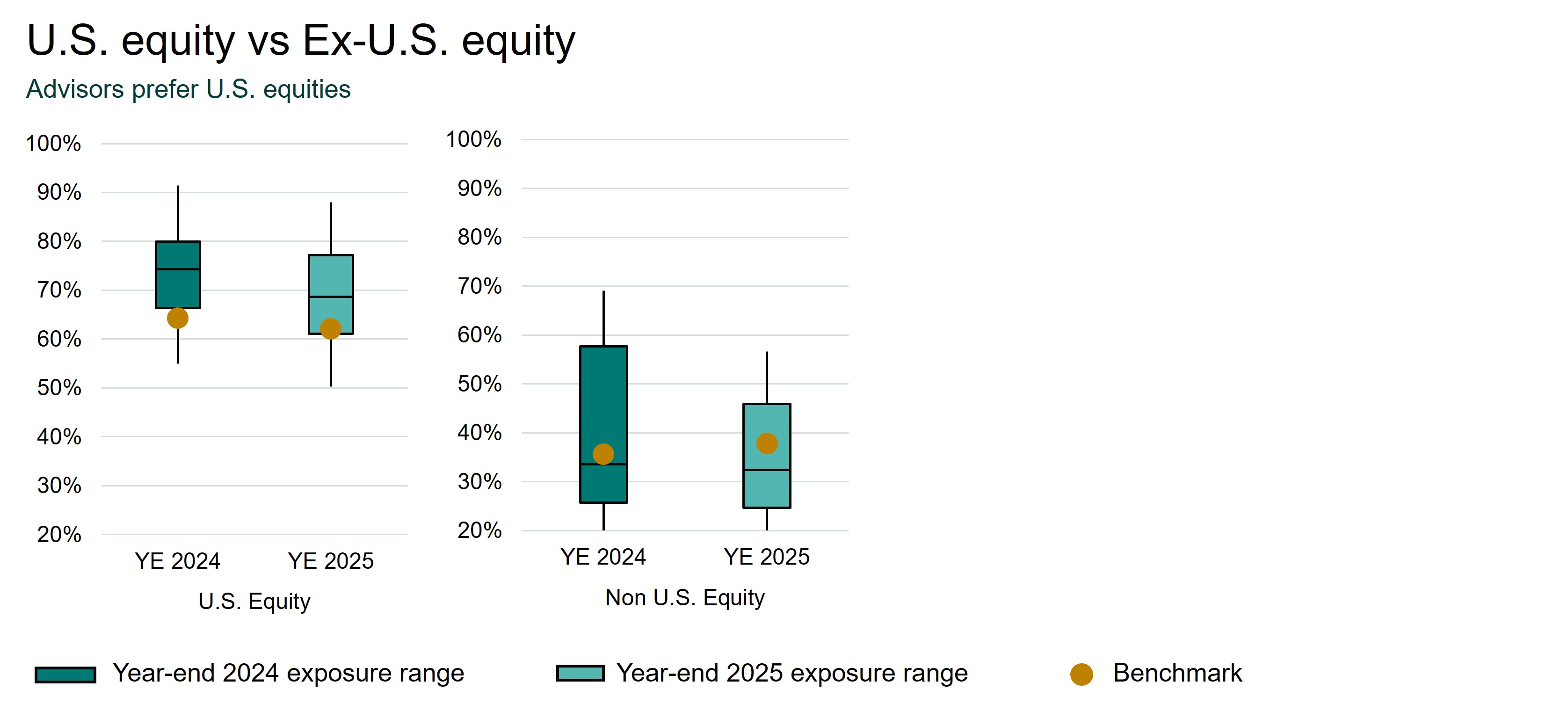
Sources: Vanguard and Morningstar, Inc., as of December 31, 2025.
Note: 399 equity sleeves observed at year-end 2024, with an average of 6 tickers per sleeve. 480 equity sleeves observed at year-end 2025, with an average of 10 tickers per sleeve. Equity charts include all observed portfolios in each time period. Equity benchmark for domestic vs. international chart: FTSE Global All Cap TR USD. Equity benchmark for international developed vs. emerging markets chart: FTSE Global All Cap ex US TR USD.
This reallocation was primarily directed toward developed markets outside the U.S., with increased exposure to Japan and Europe. U.S. advisors’ international equity allocations continued to favor developed markets over emerging markets, while LATAM advisors—despite increasing developed market exposure during 2025—remained less allocated to developed markets than U.S. advisors and broadly neutral toward emerging markets.
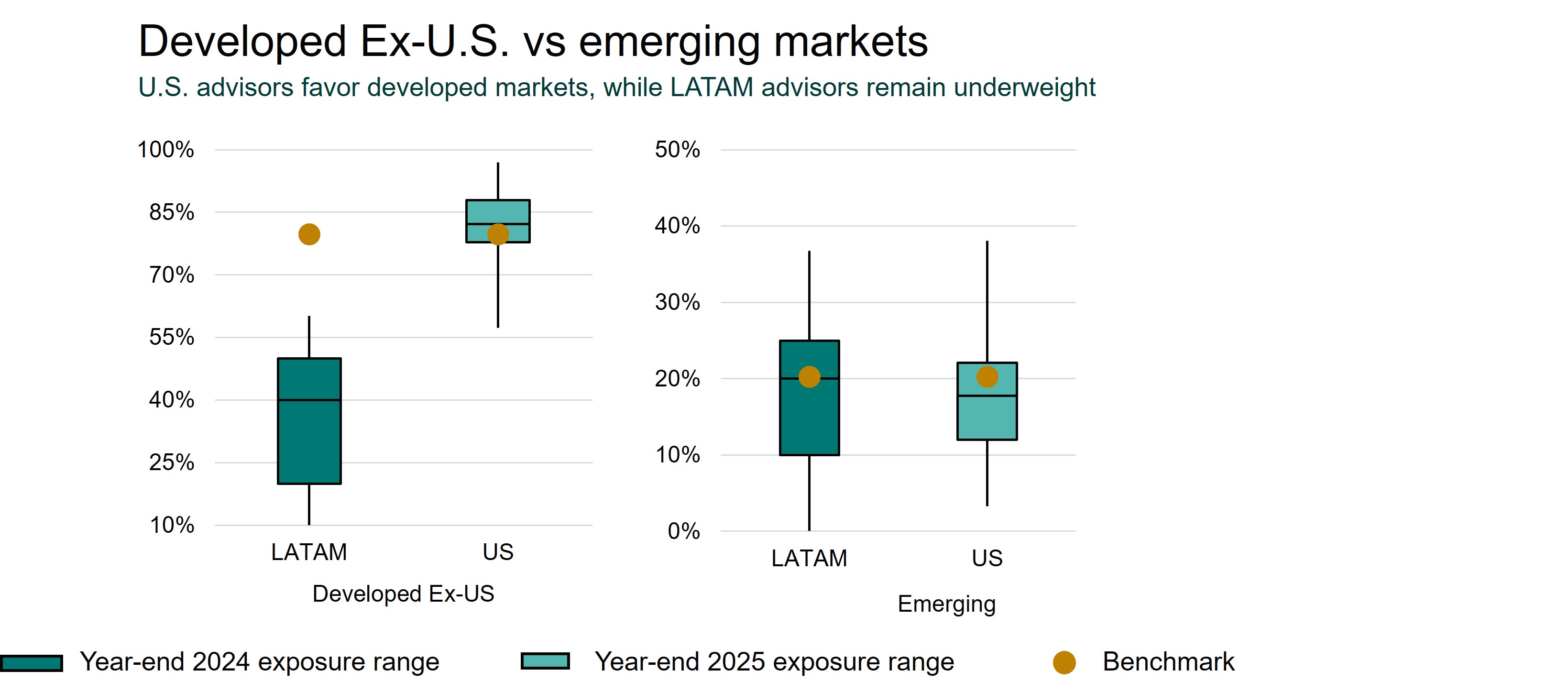
Sources: Vanguard and Morningstar, Inc., as of December 31, 2025.
Note: For LATAM clients: 399 equity sleeves observed at year-end 2024, with an average of 6 tickers per sleeve. 480 equity sleeves observed at year-end 2025, with an average of 10 tickers per sleeve. For US advisors: 1,732 equity sleeves observed at year-end 2024, with an average of 12 tickers per sleeve. 1,808 equity sleeves observed at year-end 2025, with an average of 10 tickers per sleeve.
Equity charts include all observed portfolios in each time period. Equity benchmark for domestic vs. international chart: FTSE Global All Cap TR USD. Equity benchmark for international developed vs. emerging markets chart: FTSE Global All Cap ex US TR USD.
In line with Vanguard’s strategic positioning, LATAM advisors increased exposure to mid‑ and small‑capitalization equities, primarily through value‑oriented strategies. This position reflects expectations that mid‑ and small‑cap companies may benefit as adopters rather than creators of new technologies over the next decade.
Both LATAM and U.S. advisors exhibited a preference for value equities, while maintaining an underweight to growth, particularly among U.S. advisors. Overall size and style positioning across both regions remained consistent with a long‑term, valuation‑aware framework.
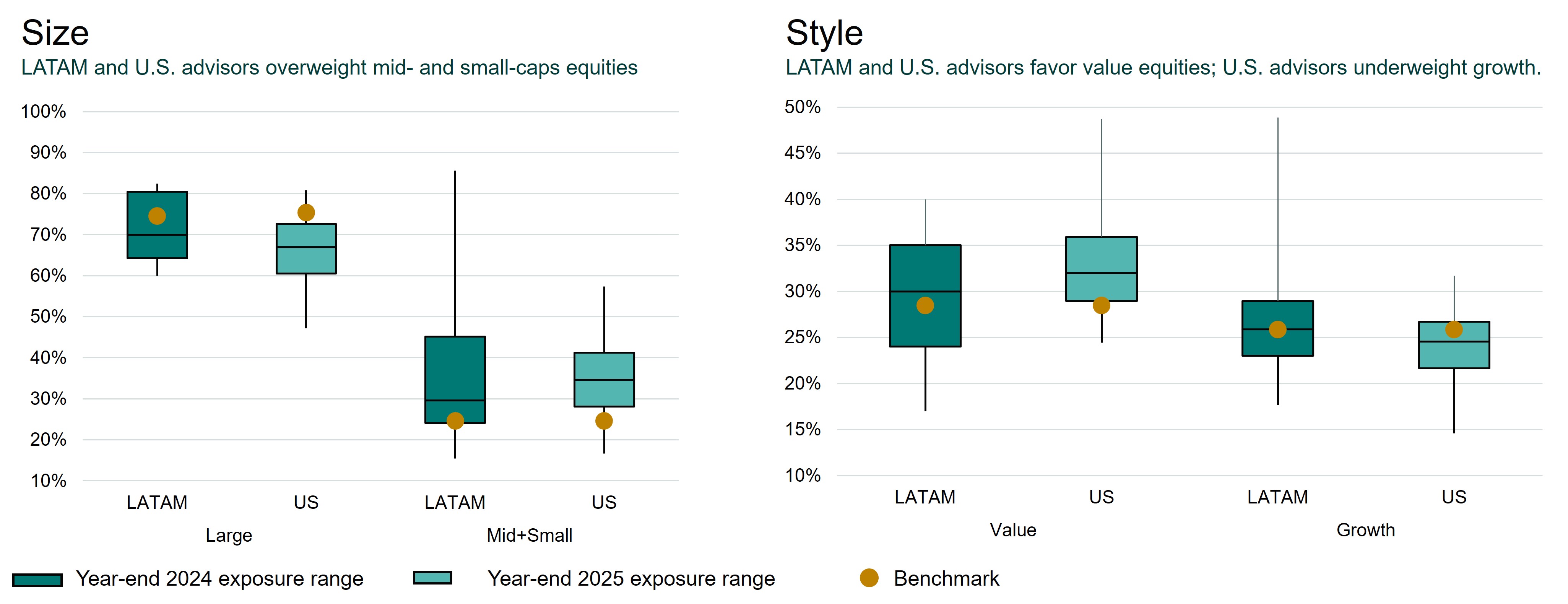
Sources: Vanguard and Morningstar, Inc., as of December 31, 2025.
Note: For LATAM clients: 399 equity sleeves observed at year-end 2024, with an average of 8 tickers per sleeve. 480 equity sleeves observed at year-end 2025, with an average of four tickers per sleeve.. For US advisors 1,732 equity sleeves observed at year-end 2024, with an average of 12 tickers per sleeve. 1,808 equity sleeves observed at year-end 2025, with an average of 10 tickers per sleeve.
Equity charts include all observed portfolios in each time period. Benchmark for both charts: FTSE Global All Cap TR USD.
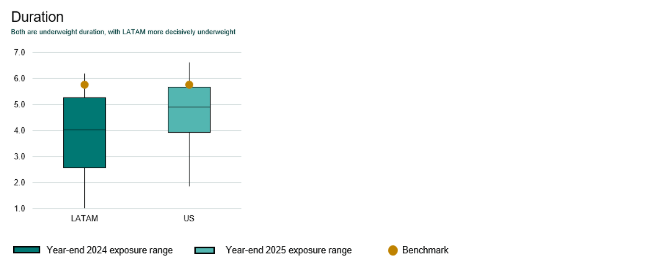
Duration management remained a key differentiator across portfolios. LATAM advisors continued to position underweight duration throughout 2025, maintaining an average duration of approximately four years, compared with a global benchmark duration closer to six years. This positioning persisted despite expectations of Federal Reserve rate cuts and elevated volatility across the yield curve.
U.S. advisors similarly maintained an underweight to duration, though LATAM portfolios generally reflected a shorter duration profile.
Sources: Vanguard and Morningstar, Inc., as of December 31, 2025.
Note: For LATAM clientes164 fixed income sleeves observed at year-end 2024, with an average of three tickers per sleeve. 250 fixed income sleeves observed at year-end 2025, with an average of four tickers per sleeve. For US advisors 1,749 fixed income sleeves observed at year-end 2024, with an average of five tickers per sleeve. 2,000 equity sleeves observed at year-end 2025, with an average of five tickers per sleeve.
Fixed income benchmark: Bloomberg U.S. Aggregate Float-Adjusted Index. High active fixed income portfolios represent the top half of observed portfolios by percentage of active management use. Low active fixed income portfolios represent the bottom half of observed portfolios by percentage of active management use.
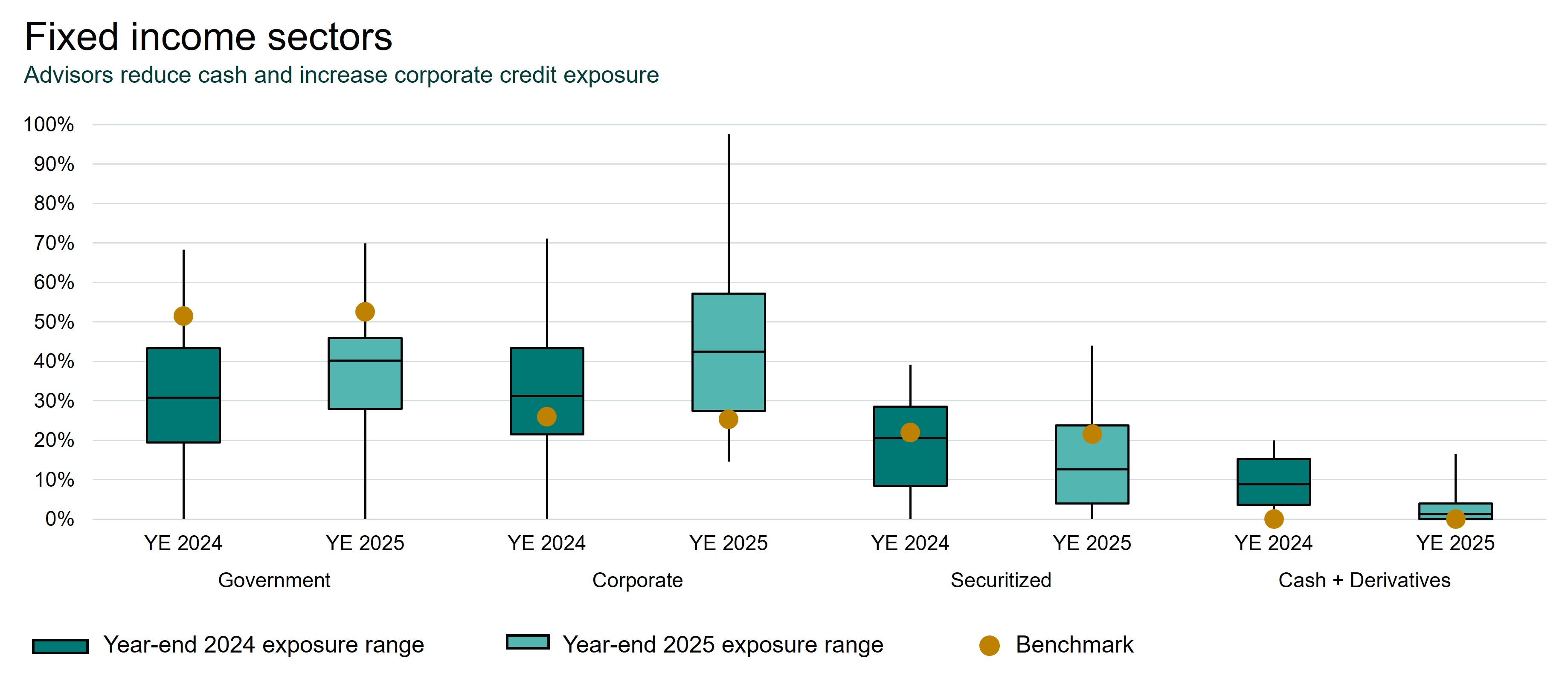
During 2025, LATAM advisors increased their allocation to U.S. fixed income, driven largely by a rotation out of cash and into corporate bonds. This shift aimed at positioning portfolios for an easing monetary cycle while maintaining attractive income levels in a higherrate environment.
Sources: Vanguard and Morningstar, Inc., as of December 31, 2025.
Note: 164 fixed income sleeves observed at year-end 2024, with an average of three tickers per sleeve. 250 fixed income sleeves observed at year-end 2025, with an average of four tickers per sleeve. Fixed income charts include all observed portfolios in each time period. Fixed income benchmark: Bloomberg U.S. Aggregate Float-Adjusted Index.
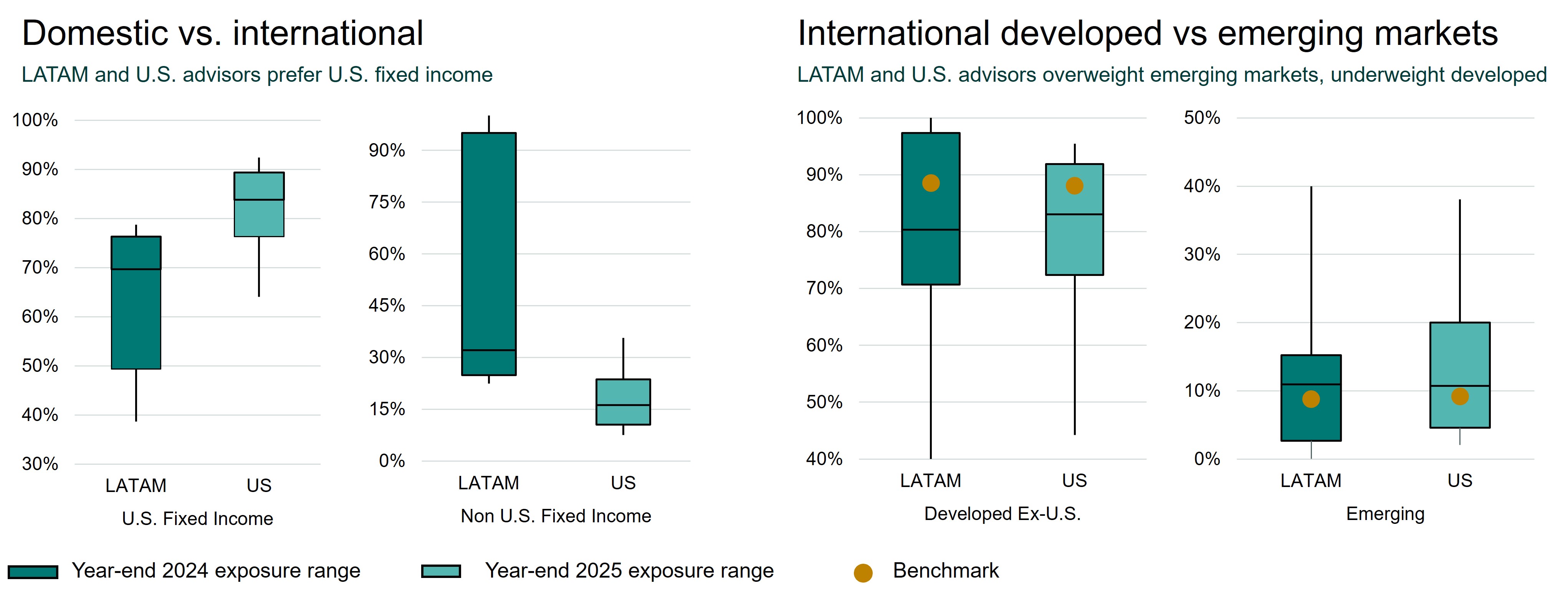
Regionally, a long‑standing preference for U.S. fixed income persisted. However, as rate volatility increased and the Federal Reserve entered a cutting cycle, both LATAM and U.S. advisors demonstrated greater interest in diversifying fixed income exposure outside the U.S.
A closer look at regional allocations shows that both groups tended to overweight emerging market bonds relative to developed ex‑U.S. bonds, attracted by higher yields and improving credit quality. These allocations were predominantly implemented through active strategies.
Sources: Vanguard and Morningstar, Inc., as of December 31, 2025.
Note: 164 fixed income sleeves observed at year-end 2024, with an average of three tickers per sleeve. 250 fixed income sleeves observed at year-end 2025, with an average of four tickers per sleeve. For US advisors 1,749 fixed income sleeves observed at year-end 2024, with an average of five tickers per sleeve. 2,000 fixed income sleeves observed at year-end 2025, with an average of five tickers per sleeve.
Fixed income charts include all observed portfolios in each time period. Fixed income benchmark for international developed vs. emerging markets chart: Bloomberg Global Aggregate Ex-U.S. Float Adj RIC Capped.
Conclusion
Portfolio positioning among LATAM and U.S. advisors in 2025 reflects disciplined adaptation to a more uncertain investment environment. LATAM portfolios continued to emphasize cost efficiency, shorter duration, and selective credit risk, while U.S. advisors relied more heavily on active management, particularly within fixed income.
Despite these differences, both groups remained broadly aligned around long‑term diversification principles, maintaining exposure to U.S. equities, favoring value over growth, and gradually increasing geographic diversification. Together, these trends highlight how portfolio construction choices can differ across regions while remaining grounded in consistent long‑term investment frameworks.
Notes:
Data provided by Morningstar is property of Morningstar and Morningstar’s data providers and it should therefore not be copied or distributed. Morningstar and its data providers are not responsible for any certification or representation with respect to data validity, certainty, or accuracy and are therefore not responsible for any losses derived from the use of such information.
Bloomberg® and Bloomberg Indexes mentioned herein are service marks of Bloomberg Finance LP and its affiliates, including Bloomberg Index Services Limited (“BISL”), the administrator of the index (collectively, “Bloomberg”) and have been licensed for use for certain purposes by Vanguard. Bloomberg is not affiliated with Vanguard and Bloomberg does not approve, endorse, review, or recommend the Financial Products included in this document. Bloomberg does not guarantee the timeliness, accurateness or completeness of any data or information related to the Financial Products included in this document.
Vanguard Mexico is not responsible for and does not prepare, edit, or endorse the content, advertising, products, or other materials on or available from any website owned or operated by a third party that may be linked to this email/document via hyperlink. The fact that Vanguard Mexico has provided a link to a third party's website does not constitute an implicit or explicit endorsement, authorization, sponsorship, or affiliation by Vanguard with respect to such website, its content, its owners, providers, or services. You shall use any such third-party content at your own risk and Vanguard Mexico is not liable for any loss or damage that you may suffer by using third party websites or any content, advertising, products, or other materials in connection therewith.