In a similar vein, what alarmed the market about the recent tariff announcements was not that new tariff policies were being pursued. Rather, it was the magnitude and scope of these policies, and the pace at which they unfolded, that had been largely unknowable and exacerbated the volatility.
Truly disruptive risk is often unknowable ahead of time. Humility regarding this truth can help investors maintain a healthy perception of risk. Accepting that unknowable risks periodically roil markets can foster a flexible and measured response when tail risks—or extreme market developments—emerge, mitigating the impact of unforeseen events and preventing panic-driven decisions.
Principle 2: Have a robust asset allocation
Because the future is uncertain, and some risks are unknowable, it makes sense to find a robust solution—one that provides results that are good enough across a range of circumstances, rather than optimal under some scenarios but highly undesirable under others. More than being balanced by some combination of stocks, bonds, and cash and diversified within each asset class, a robust portfolio is one the investor can maintain, especially in extreme market conditions.1
Rigorous capital market return projections that consider the extremes are also critical to robustness. That’s because poor long-term results are a greater risk than short-term volatility for long-term investors. In practice, a robust approach to portfolio construction considers a diverse range of return environments over the investor’s investment horizon and achieves an allocation that would be suitable across these environments.
A new book by Joe Davis, Vanguard global chief economist, provides an example of such an approach for investors with seven- to 10-year horizons. Placing the odds of the economic environment fundamentally changing over the next decade at above 80%, this approach weighs two starkly different return environments. The resulting portfolio is robust for both: 1) an optimistic environment in which AI-driven productivity drives high economic growth and market valuations; and 2) a pessimistic environment where increasing structural deficits put upward pressure on inflation and yields, while pulling down equity valuations.
Principle 3: Be optimistic but prepared for downturns
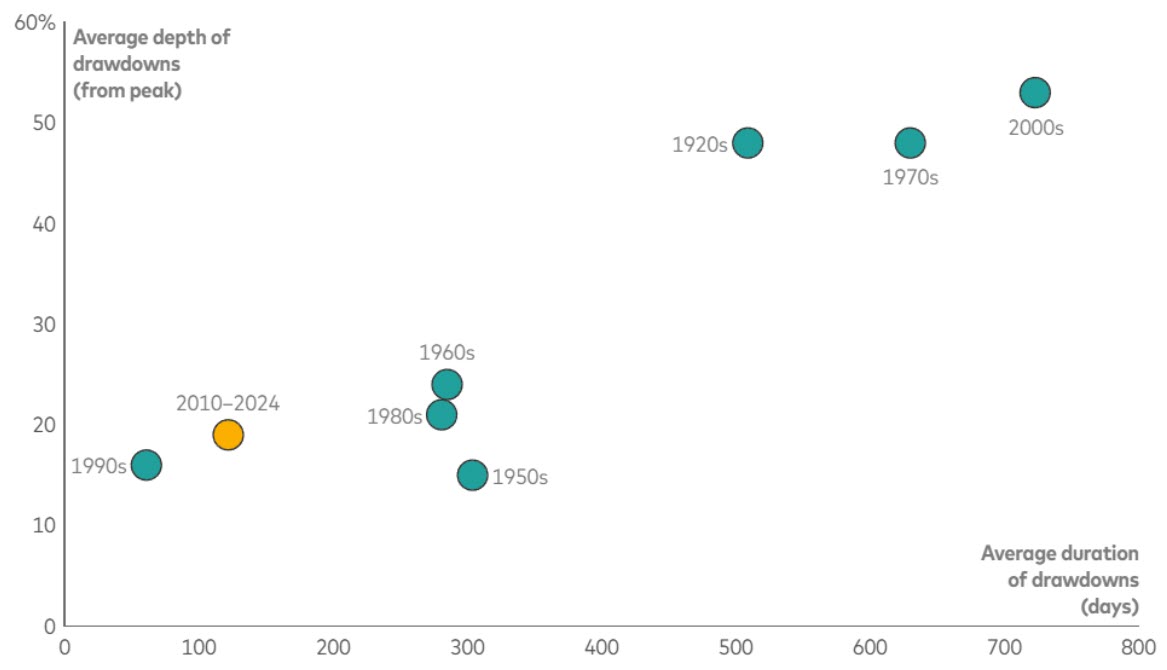
Balanced investors must thoughtfully manage downside risk. Sticking with an allocation during significant drawdowns requires realistic expectations about one’s tolerance for pain. In today's market, this means having realistic expectations about potential drawdowns and not relying on overly optimistic return expectations based on recent performance.
Mild stock-price corrections of recent years could give way to deeper, longer-lasting declines