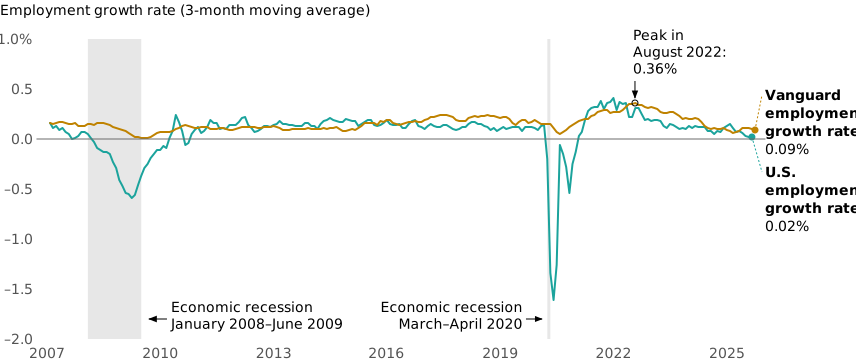
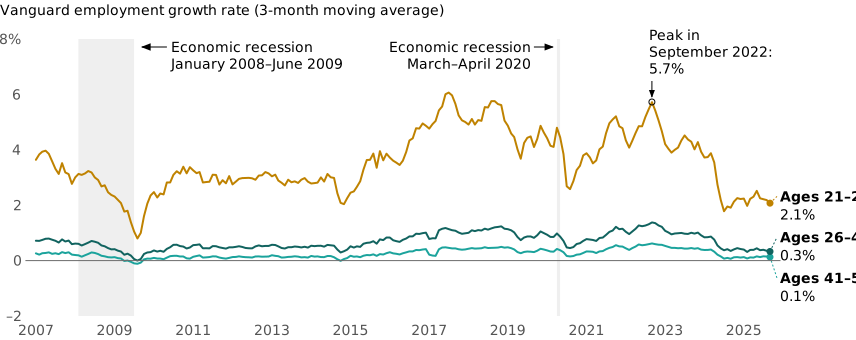
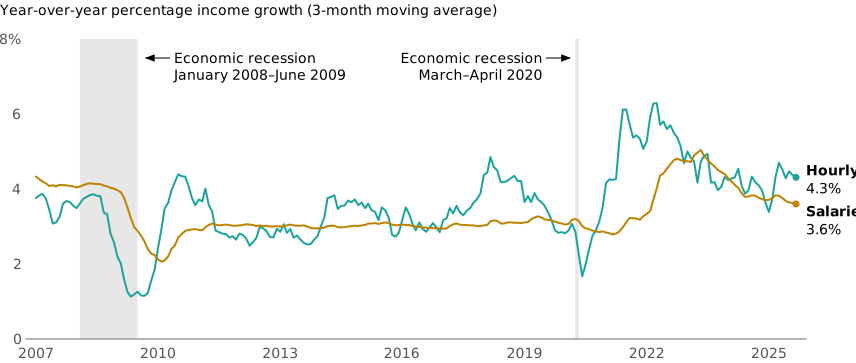
Year-on-year percentage growth (3-month moving average) | Created with Datawrapper
Note: The two vertical bars indicate economic recessions, as identified by the National Bureau of Economic Research. The Vanguard income growth series considers employees who made 401(k) contributions in all 12 months of the preceding calendar year. For each employee contribution, we infer the paycheck amount as the contribution amount divided by the contribution rate. For each employee and each month, we compute total income divided by the number of paychecks. We then compute the year-over-year percentage change in income per paycheck (current month income relative to income 12 months ago) for each employee and take the median across employees. Finally, we report a three-month moving average of the monthly median growth rate. We exclude monthly observations in which the employee earns less than $200 per paycheck or in which the smallest paycheck is less than 10% of the largest paycheck. Employees are classified as hourly if at least 45% of their paychecks in the preceding calendar year changed by at least $1 relative to the lagged paycheck value. The 45% cutoff is benchmarked against external payroll processing data from Earnings Instability (Ganong et al., 2024). There are approximately 1.5 million 401(k) participants in the Vanguard sample in 2025.
Source: Vanguard.
What we (and the Fed) will be watching
Although hiring momentum has slowed, Vanguard data illustrate persistent labor market resilience—wage growth remains solid and employment levels are stable. Going forward, the income trajectory of hourly workers will be a key indicator for assessing shifts in economic conditions and consumer behavior.
Contributors:
Fiona Greig, Ph.D., Vanguard Global Head of Investor Research and Policy
Adam Schickling, CFA, Vanguard U.S. Senior Economist
Aaron Goodman, Ph.D., Vanguard Investment Strategy Analyst
Nicky Zhang, Vanguard Investment Strategy Analyst
[1] Nonfarm payroll data is released on the first Friday of each month by the U.S. Bureau of Labor Statistics and is revised over the following two months as additional survey responses are received. A more comprehensive revision occurs each February, in which employment figures are retroactively adjusted based on unemployment insurance tax records from the Quarterly Census of Employment and Wages.
[2] Source for hourly workers representing 55% of the U.S. workforce: U.S. Bureau of Labor Statistics, available at bls.gov/opub/reports/minimum-wage/2023/.
[3] The year-over-year change in the Consumer Price Index for All Urban Consumers (CPIAUCSL) was 2.9% in August 2025.
Notes:
All investing is subject to risk.
CFA® is a registered trademark owned by CFA Institute.
This document is not intended to provide tax advice or make and exhaustive analysis of the tax regime of the securities described herein. We strongly recommend seeking professional tax advice from a tax specialist.
Vanguard Mexico is not responsible for and does not prepare, edit, or endorse the content, advertising, products, or other materials on or available from any website owned or operated by a third party that may be linked to this email/document via hyperlink. The fact that Vanguard Mexico has provided a link to a third party's website does not constitute an implicit or explicit endorsement, authorization, sponsorship, or affiliation by Vanguard with respect to such website, its content, its owners, providers, or services. You shall use any such third-party content at your own risk and Vanguard Mexico is not liable for any loss or damage that you may suffer by using third party websites or any content, advertising, products, or other materials in connection therewith.